
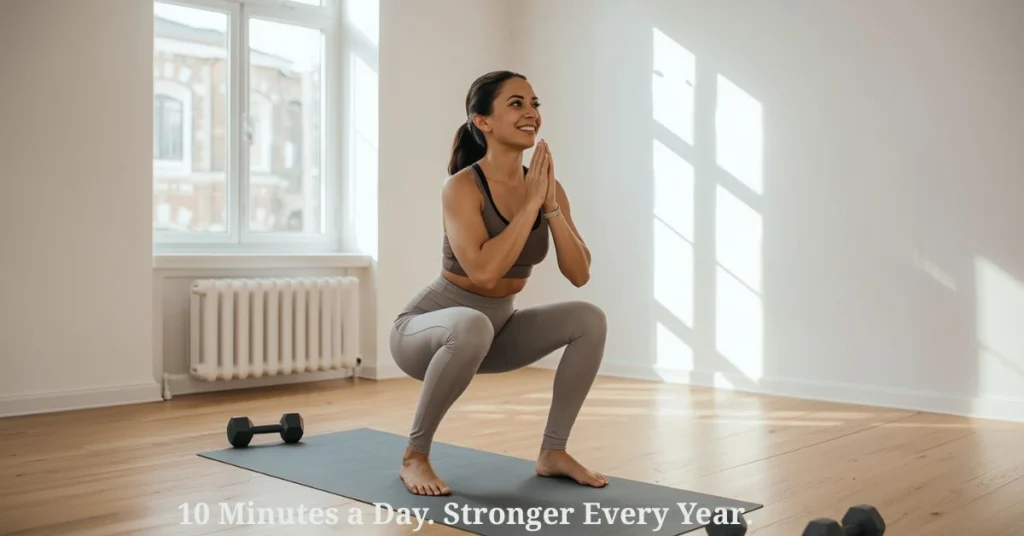
Beginner-Friendly Strength Plan + 30 Day Challenge
There is a quiet revolution happening in living rooms, backyards, and bedrooms across America. Women and men in their 40s, 50s, and beyond are reclaiming their strength — not inside expensive gyms, not with complicated equipment, but with focused, intentional movement right where they live. If you have ever told yourself you are too busy, too tired, or too out of shape to start, this manual will be written specially for you. A consistent 10 minutes daily workout to stay fit after 40 at home is not just possible — according to exercise science, it may be one of the most effective approaches available for your age group. Additionally, incorporating a 10 minute daily workout to stay fit after 40 at home into your routine will enhance your overall health and well-being.
Let’s break down exactly how to do it, why it works, and what a realistic weekly plan looks like.
Why Working Out After 40 Feels Different — And What to Do About It
“…gradual decline in muscle mass called sarcopenia , losing roughly 3–5% of muscle per decade…”
Your frame after forty isn’t broken. It is different — and that difference deserves a smarter strategy.
Starting around age 35 to 40, adults experience a gradual decline in muscle mass called sarcopenia, losing roughly 3–5% of muscle per decade if they remain sedentary. Metabolism slows. Recovery takes longer. Hormonal shifts in both women and men affect fat distribution, bone density, and energy levels.
The good news? Research consistently shows that resistance training and consistent movement can reverse or significantly slow nearly all of these effects. You no longer want hours in a gym. You need consistency, the right exercises, and a plan built for where you actually are in life.
Here is what changes when you exercise smarter after 40:
Muscle mass increases, which boosts your resting metabolic rate
Bone density improves, decreasing osteoporosis risk
Joint pain decreases when surrounding muscles are strengthened
Energy and mood stabilize due to endorphin release and better sleep
Balance and posture improve, reducing fall risk as you age
The barrier is never ability — it is almost always structure. That is what this text provides.
The Science Behind Short, Daily Workouts
“A landmark study published in the Journal of the American Heart Association found…”
“A landmark study published in the Journal of the American Heart Association found…”
Incorporating a 10 Minute Daily Workout to Stay Fit After 40 at Home
You are probably skeptical. Ten minutes? Can that virtually pass the needle?
A landmark study published in the Journal of the American Heart Association found that even short bouts of physical activity — as brief as 10 minutes — accumulated throughout the day significantly reduced cardiovascular risk and improved longevity markers. More recently, research from McMaster University in Canada demonstrated that brief, high-intensity interval-style exercise performed consistently produced comparable muscle and endurance gains to longer moderate-intensity sessions.
The key phrase is performed consistently. A 10-minute workout you do every day will always outperform a 45-minute session you do twice a month due to the fact lifestyles were given withinside the way.
After 40, consistency beats intensity. Every single time.
At Home Workouts to Build Muscle: What Equipment Do You Actually Need?
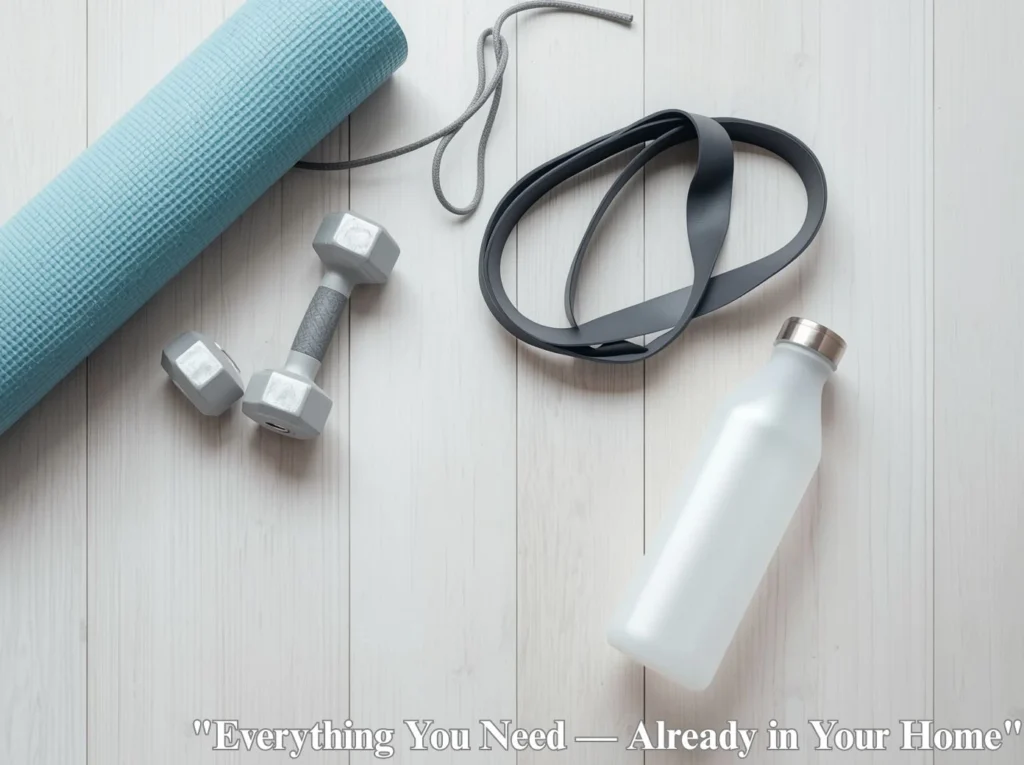
One of the biggest myths about at home workouts to build muscle is that you need a garage complete system to peer results. You do not.
For the workouts in this guide, you will need:
Your bodyweight (always available, always free)
A set of light to medium dumbbells (optional but helpful — 5 to 15 lbs for most women, 10 to 25 lbs for most men)
A sturdy chair or couch for assisted exercises
A yoga mat or folded blanket for floor work
A resistance band (optional — costs under $15 and adds significant variety)
That is it. No gym membership. No mirrors. No judgment.
Full Week Workout Plan for Muscle Gain — Designed for the 40+ Body
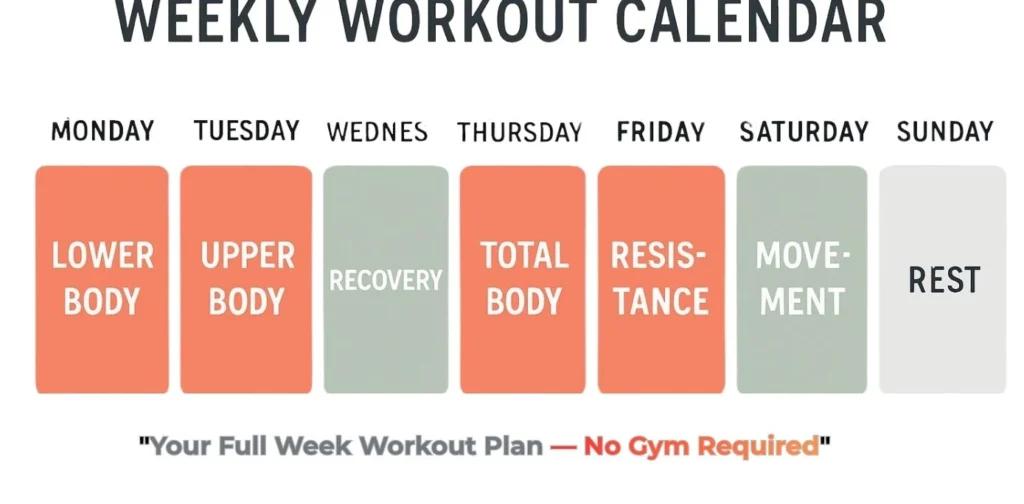
Structure is everything. Without a plan, most people either do too much too soon and get injured, or repeat the same two exercises and plateau. The schedule below is specifically designed as a full week workout plan for muscle gain that respects recovery time, targets every major muscle group, and fits into real life.
The Golden Rules of This Plan:
Rest days are not lazy days — they are when muscles actually grow
Warm up for 2 minutes before every session (march in place, arm circles, hip rolls)
Cool down for 1 minute after every session (gentle stretching)
Hydrate earlier than and after
Listen in your body — discomfort is normal, sharp ache is a sign to stop
Monday — Lower Body Strength
Focus: Glutes, Quads, Hamstrings, Calves
Duration: 10 Minutes
ExerciseReps/DurationRestBodyweight Squats15 reps20 secReverse Lunges (alternating)10 reps each leg20 secGlute Bridges15 reps20 secCalf Raises (use chair for balance)20 reps20 secWall Sit30 seconds20 sec
Repeat the circuit twice.
Trainer’s Tip: If standard squats bother your knees, try a wider stance or place a folded towel under your heels. Never sacrifice joint comfort for depth.
Tuesday — Upper Body & Core
Focus: Shoulders, Arms, Chest, Core
Duration: 10 Minutes
ExerciseReps/DurationRestPush-Ups (modified or full)10–15 reps20 secDumbbell Shoulder Press12 reps20 secTricep Dips (using chair)10 reps20 secDumbbell Bicep Curls12 reps20 secPlank Hold20–30 seconds20 sec
Repeat the circuit twice.
Trainer’s Tip: For modified push-ups, place knees on the floor. This reduces load by approximately 50% while still effectively training the chest, shoulders, and triceps.
Wednesday — Active Recovery & Flexibility
Focus: Mobility, Stress Reduction, Joint Health
Duration: 10 Minutes
This day is not a day off — it is a strategic recovery session. Tight muscles and stiff joints are common complaints after 40, and ignoring mobility is one of the fastest ways to accumulate injury.
Cat-Cow Stretches: 10 slow repetitions (spinal mobility)
Hip Flexor Stretch: Hold 30 seconds each side (counters prolonged sitting)
Child’s Pose: Hold 45 seconds (lower back relief)
Standing Quad Stretch: Hold 30 seconds every side
Neck and Shoulder Rolls: 60 seconds
Seated Spinal Twist: Hold 30 seconds every side
Move slowly, breathe deeply, and treat this day as a gift to your body.
Thursday — Total Body Circuit
Focus: Full-Body Strength and Cardio Combined
Duration: 10 Minutes
ExerciseDurationRestJumping Jacks (or low-impact step jacks)40 seconds20 secBodyweight Squats40 seconds20 secPush-Ups40 seconds20 secHigh Knees (or marching in place)40 seconds20 secGlute Bridges40 seconds20 sec
Repeat the circuit twice.
Trainer’s Tip: If joint impact is a concern, swap all jumping movements for their low-impact equivalents. Step jacks in place of leaping jacks. Marching as opposed to excessive knees. Same cardiovascular benefit, far less stress on knees and hips.
Friday — Best Workout Schedule for Muscle Gain: Targeted Resistance Day
Friday is the day to layer in slightly more deliberate resistance work. This aligns with what exercise physiologists describe as the best workout schedule for muscle gain — ending the week with a focused strength session allows the weekend’s relative rest to fuel muscle protein synthesis at its peak.
Focus: Back, Core, Glutes
Duration: 10 Minutes
ExerciseReps/DurationRestResistance Band Rows (or dumbbell rows)12 reps20 secSuperman Hold12 reps, 2-sec hold20 secDead Bug (core stability)8 reps each side20 secDonkey Kicks15 reps each side20 secBird Dog10 reps each side20 sec
Repeat the circuit twice.
Saturday — Enjoyable Movement
Duration: 10–30 Minutes (Your Choice)
This is the day to move in ways that feel good rather than structured. Go for a walk. Ride a bike. Dance for your kitchen. Garden. Play together with your youngsters or grandkids. The goal is to keep the body moving without the psychological weight of a “workout.”
Enjoyable movement is what sustains a fitness lifestyle long-term. Never underestimate its value.
Sunday — Full Rest
Rest isn’t failure. It is physiology. Muscle tissue repairs and grows during rest, not during the workout itself. Protect your Sundays and you will come back to Monday stronger.
Weight Lifting Routine for Women Over 40: Busting the Biggest Myths
“Women produce roughly 15–20 times less testosterone than men…”
“Women produce roughly 15–20 times less testosterone than men…”
If you are a woman reading this, there is a good chance someone has told you that lifting weights will make you “bulky.” That is one of the most persistent and damaging fitness myths of the last 50 years — and it is completely false.
Here is the truth about a weight lifting routine for women in their 40s and beyond:
Myth #1: Weights will make you look masculine.
Reality: Women produce roughly 15–20 times less testosterone than men, making it physiologically difficult to build large muscle mass. What lifting does instead is create a leaner, more toned appearance, improve posture, and significantly boost metabolic rate.
Myth #2: Cardio is more important for weight loss.
Reality: Muscle is metabolically energetic tissue. Every pound of muscle you carry burns approximately 6–10 additional calories per day at rest. Building and maintaining muscle through resistance training creates a lasting metabolic advantage that cardio alone cannot provide.
Myth #3: You are too old to start lifting.
Reality: Studies have shown meaningful muscle growth (hypertrophy) in women and men well into their 70s and 80s while regular resistance schooling is introduced. Starting at 40 or 50 gives you decades of benefit ahead.
Myth #4: You will get injured.
Reality: Injury risk from properly performed resistance training is extremely low — far lower, in fact, than the long-term injury risk of remaining sedentary.
Start with light weights, master your form, and progress gradually. That is the whole formula.
10 Minute Daily Workout to Stay Fit After 40 at home: A Special Note
“Perimenopause and menopause typically begin between ages 40–55…”
“Perimenopause and menopause typically begin between ages 40–55…”
While the workout plan above works for all genders, women experience some distinct physiological factors after 40 that are worth addressing directly.
Perimenopause and menopause typically begin between ages 40–55 and bring hormonal fluctuations that can cause fatigue, disrupted sleep, increased belly fat storage, mood changes, and accelerated bone loss. These are real, validated experiences — not excuses.
The 10 minute daily workout to stay fit after 40 female framework is specifically valuable because:
Short sessions reduce cortisol spikes, which are elevated during perimenopause and contribute to belly fat storage
Resistance training directly combats bone density loss, which accelerates rapidly in the first years after menopause
Daily motion regulates sleep hormones, supporting cope with one of the maximum not unusualplace perimenopause complaints
Endorphin release from even brief exercise has been clinically shown to reduce mood instability during hormonal transitions
Pair this routine with adequate protein intake (0.7–1 gram per pound of body weight), prioritize sleep, and work with your healthcare provider if you are navigating significant hormonal symptoms.
Gym Workout Plan for Beginners vs. Home Workouts: Which Is Right for You?
If you have ever been curious about a gym workout plan for beginners but felt intimidated by the environment, you are not alone. Gyms can feel overwhelming — especially if you have not exercised in years and are surrounded by people who seem to recognise precisely what they’re doing.
Here is a sincere comparison:
| Factor | Home Workout | Gym Workout |
|---|---|---|
| Cost | Free to low-cost | $30–$80+/month |
| Convenience | Maximum — no commute | Requires travel |
| Equipment | Limited (bodyweight, dumbbells) | Extensive variety |
| Social Accountability | Self-motivated | Community available |
| Privacy | Complete | Public environment |
| Expert Access | YouTube/apps only | Trainers on site |
| Barrier to Entry | Very low | Higher |
For most people over 40 who are just beginning or returning to fitness, starting at home removes the friction that prevents consistency. Once you have built a habit — typically 6–8 weeks of consistent movement — transitioning to or supplementing with a gym becomes far less daunting.
The quality exercising surroundings is the only you’ll truly use.
Free Exercise Routine for 50-Year-Old Woman at Home: Adapting as You Age
If you are closer to 50 — or already past it — the principles above still apply, but some particular diversifications will serve you well.
This free exercise routine for 50-year-old woman at home framework incorporates the following adjustments:
1. Extend Your Warm-Up
At 50+, joints and connective tissue need slightly longer to prepare for movement. Add 2–3 extra minutes of gentle mobility work before each session.
2. Prioritize Balance Work
Fall prevention becomes increasingly important after 50. Add single-leg exercises like single-leg stands (hold for 30 seconds each side) or heel-to-toe walking into your routine.
3. Reduce Impact Further
Replace all jumping exercises with controlled low-impact alternatives. Your cardiovascular system gets the same stimulus without the joint stress.
4. Add Pelvic Floor Awareness
Many women after 50 deal with pelvic floor weakening. Incorporate Kegel exercises (10 slow contractions, held for 5 seconds each) into your daily routine — they can be done at the same time as seated at any time.
5. Be Patient with Progress
Recovery at 50 takes slightly longer than at 40. If you are significantly sore after a session, take an extra rest day rather than pushing through. Overtraining is counterproductive at any age.
6. Celebrate Non-Scale Victories
Energy levels. Sleep quality. Mood stability. The ability to carry groceries or climb stairs without getting winded. These metrics matter — often more than what the scale says.
Nutrition: The Missing Half of the Equation
“Aim for 0.7–1 gram of protein per pound of body weight…”
No workout plan is complete without a conversation about what fuels it. You do not need a complicated diet — but a few fundamentals make a significant difference after 40.
Protein Is Non-Negotiable
Muscle protein synthesis (the process by which your body repairs and builds muscle) becomes less efficient as you age. To compensate, you need slightly more protein than younger adults. Aim for a serving of lean protein at every meal: eggs, chicken, Greek yogurt, beans, lentils, tofu, cottage cheese, or fish.
“Omega-3 fatty acids directly support hormonal health…”
Do Not Fear Carbohydrates
Carbs are your primary fuel source for exercise. Choose entire meals sources — oatmeal, candy potatoes, brown rice, fruit, and entire grain bread — and time Them round your workout routines while possible.
Healthy Fats Support Hormones
Omega-3 fatty acids (found in salmon, walnuts, flaxseed, and avocado) directly support hormonal health, reduce inflammation, and aid joint lubrication — all particularly relevant after 40.
Hydration Is More Important Than You Think
Many adults are chronically mildly dehydrated, which manifests as fatigue, poor concentration, and sluggish muscle function. Drink at least half your body weight in ounces of water daily, and more on workout days.
How to Stay Consistent: The Psychology of Habit Formation After 40
The biggest challenge to any fitness plan is not physical — it is psychological. Life is full. Energy varies. Motivation is unreliable. Here is what actually works for building lasting consistency.
Habit Stack Your Workout
Attach your 10-minute session to something you already do every day — right after your morning coffee, immediately before your shower, or the instant you exchange your painting clothes. Existing habits become the anchor for new ones.
Set a Minimum, Not a Goal
Your minimum standard is simply to show up. Even on days when you only do five minutes, that is a win. The habit of beginning is more powerful than the duration.
Track Your Streak, Not Your Performance
Use a simple paper calendar to mark each day you complete a workout. After two weeks, the streak itself becomes motivating — you will not want to break it.
Prepare the Night Before
Set your mat out. Put your dumbbells by the couch. Lay your workout clothes at the foot of your bed. Reducing friction makes the first step automatic.
Find Your “Why” and Write It Down
Wanting to have energy to play with grandchildren. Wanting to travel in your 60s without physical limitation. Wanting to sense sturdy and succesful to your personal body. Your reason is personal — make it vivid and revisit it often.
Tracking Progress: What to Measure After 40
The scale is one of the least useful tools for measuring fitness progress after 40, particularly for women. Here is what to tune instead:
Energy levels: Rate them 1–10 each morning in a simple journal
Sleep quality: Are you falling asleep faster, napping greater soundly?
Functional strength: Can you carry more, move more easily, climb stairs without fatigue?
Resting coronary heart charge: A losing resting coronary heart charge shows enhancing cardiovascular fitness
Waist circumference: A more meaningful metabolic health marker than total weight
Mood and mental clarity: Often the first and most noticeable improvement
Photos each four weeks: Visual change is often apparent before scale change
Take your measurements and initial photos before you begin. Revisit them at 30, 60, and 90 days.
Your First Week Starts Today
Here is the thing about starting a fitness routine after 40: The toughest component isn’t always the workout. The hardest part is deciding that you are worth the 10 minutes.
You are.
The plan above is free. The gadget is minimal. The time dedication is ten minutes a day. The technological know-how is solid. Everything you need to begin exists in the space you are sitting in right now.
You do not need to be at your best weight to start. You no longer want to have exercised before. You do not need to wait until Monday, or next month, or after the holidays.
You need to stand up, press play on your favorite song, and do the first squat.
After 40, every single workout is an investment in the next decade of your life. Make it today.
Quick-Reference Summary
| Day | Focus | Duration |
| Monday | Lower Body Strength | 10 Minutes |
| Tuesday | Upper Body & Core | 10 Minutes |
| Wednesday | Active Recovery & Flexibility | 10 Minutes |
| Thursday | Total Body Circuit | 10 Minutes |
| Friday | Targeted Resistance | 10 Minutes |
| Saturday | Enjoyable Movement | 10–30 Minutes |
| Sunday | Full Rest | — |
Always seek advice from your medical doctor earlier than starting any new workout program, mainly when you have current fitness conditions, Joint issues, or were sedentary for an prolonged period. The records in this text are for academic functions and no longer represent scientific advice.